

By Elyssa Emerson and Shahrbanu Haidari
The Violence I Face
Since 2021, the Taliban’s rule over Afghanistan has jeopardised the existence of Afghanistani women. What began as an act against co-education in August 2021 swiftly devolved into a full-fledged erasure of women’s visibility and value in a matter of months, systematically dismantling the rights of women through the intense scrutiny and laws placed upon them. These laws and edicts do not merely attack the freedoms of women: they undermine the lives and livelihoods of women, removing every possibility of life without a male leader and leaving women silenced and excluded.
Women have been increasingly repressed over the course of the past 4 years. At the beginning of 2022, women were banned from working outside their homes—those who previously held roles in government, the United Nations, or NGO offices were forced to send a male family member to take their place or give up their positions and salaries. Later in 2022, a law prohibiting women from entering public parks and gyms was passed throughout Afghanistan. Now, if walking outside the home, women are required to have a male companion (Mahram) with them at all times. Yet, regardless of having a Mahram to accompany them, women’s access to public places is virtually nonexistent.
The laws which claim to be for women’s protection are prisons, entrapping the present and future of Afghanistani women into that of servitude. These increasingly specific and unjust laws about the actions, appearance, professions, and education of women are denying them the right to exist. One small example of such legislation is the banning of women’s voices on the radio and of women’s appearances on TV dramas. The only potential outcome for this immense repression of women is servitude, slavery, and complete erasure.
This institutionalised repression of Afghanistani women’s existence is gender apartheid.
What is Gender Apartheid?
Gender Apartheid is a system of governance that enforces the systematic segregation and subordination of women through discriminatory laws and policies. It systematically excludes women from public spaces and spheres, codifying their inferior status and violating international principles that ensure equal human rights for all. This pervasive system, exemplified by Taliban rule in Afghanistan, ingrains male superiority and female inferiority into every sphere of life, both public and private.
Gender Apartheid’s cumulative and pervasive nature requires robust international action to address these gross human rights violations effectively. Without decisive international intervention, the plight of women and girls in Afghanistan is set to worsen under the Taliban’s oppressive rule. Concurrently, tensions between the Taliban’s de facto government and nations sheltering Afghanistani refugees are escalating, posing further humanitarian challenges.
The existing international legal framework fails to fully encompass the multifaceted nature of gender-specific crimes unfolding in Afghanistan. The urgent need to codify gender apartheid in international law is clear. Such a designation would provide a critical tool for the global community to accurately identify and condemn the Taliban’s systematic oppression of Afghanistani women and girls. By acknowledging and codifying Gender Apartheid, the international community can elevate the gravity of the situation in Afghanistan, ensuring that the world sees and responds to the Taliban’s assaults on women’s rights with the urgency and condemnation they demand.
ASDD 16 Days of Activism
Every year, from November 25th to December 10th, the global community observes 16 Days of Activism Against Gender-Based Violence, a coordinated campaign dedicated to raising awareness, promoting prevention, and mobilising action to end violence against women and girls. This period links the Day for the Elimination of Violence Against Women (Nov 25th) with Human Rights Day (Dec 10th), underscoring gender-based violence as a fundamental violation of human rights. Through advocacy, education, and community engagement, the campaign calls on individuals, institutions, and governments to work collectively toward a world where all women and girls live free from violence and discrimination.
This year’s campaign theme is UNiTE to End Digital Violence Against All Women and Girls, emphasising the urgent need to address online harassment, cyberstalking, non-consensual image sharing, and other forms of technology-facilitated abuse which increasingly threaten women’s safety and dignity throughout digital spaces.
As ASDD works to empower women and girls in Afghanistan, this year presents additional challenges as growing restrictions deprive Afghanistani women of their fundamental human rights, including limited access to the Internet. In late September, the entire country experienced an internet shutdown, and shortly thereafter, Instagram and TikTok were filtered nationwide. As public life in Afghanistan continues to deteriorate, digital spaces follow suit. Freedom of expression—already heavily suppressed—is increasingly constrained online, with numerous cases of activists being imprisoned for posting views contrary to Taliban directives. For women, these risks are compounded. Many no longer feel safe sharing their photos or opinions on social media due to pervasive harassment, explicit messages, and online abuse. Those who do speak publicly often face attacks, hate speech, and degrading comments, including being labelled with terms such as “whore” or “prostitute”.
Beyond digital violence, Afghanistani women face severe systemic restrictions in their physical life: they cannot visit hospitals without a burqa and a male guardian, they are denied the right to work and achieve economic independence, and they are prohibited from attending school or university after the age of 12. Despite being half of the country’s population, they are pushed to the margins of society. The dehumanisation women experience in Afghanistan is profound and generational, and it will take decades of sustained effort to address its impacts.
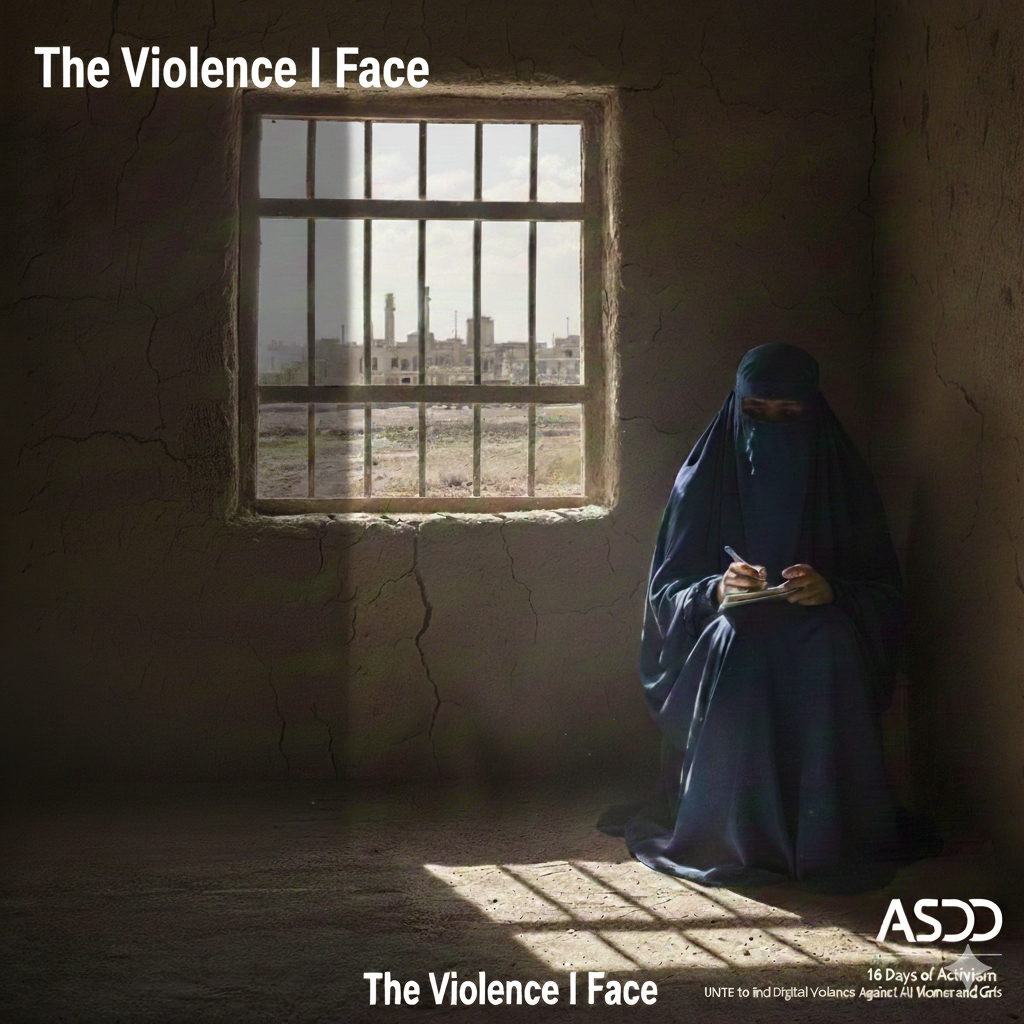
In response to this reality, ASDD has chosen the theme “Violence I Face” for this year’s campaign in Afghanistan and invited its students inside the country to write about the forms of violence they experience in their daily lives. Beginning on November 25th, we will publish our students’ essays on our website and social media platforms, accompanied by a series of articles which highlight and analyse the current situation of women in Afghanistan. These publications aim to amplify the voices of women and girls from Afghanistan, document their lived experiences, and draw international attention to the urgent need for action and solidarity.
Comments are closed.